The Rise of the Seleukid Empire (323-223 BC): Seleukos I to Seleukos III by John D. Grainger
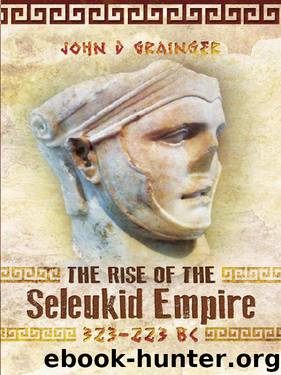
Author:John D. Grainger [Grainger, John D.]
Language: eng
Format: epub
Tags: Bisac Code 1: HIS002000, HISTORY / Ancient / General, Bic Code 1: 1QDAR
ISBN: 9781473840027
Publisher: Pen and Sword
Published: 2014-08-05T18:30:00+00:00
Chapter Ten
Antiochos I and the Galatians
One of the main purposes in appointing Antiochos as joint-king was so that he would be in office (and an experienced ruler) when Seleukos died. Ironically the same precaution taken so apparently reluctantly by Ptolemy I had worked well, whereas Seleukos’ aim was, in the short term, unsuccessful. Even so, Ptolemy II needed time to establish his own authority after the old man died. Seleukos’ careful plan failed because he was assassinated; his unexpected death meant the transition was anything but smooth. It appears that this was a contingency not anticipated, which is surprising given the casualty rate amongst Macedonian rulers from violence of one sort or another. Indeed the whole adventure of Seleukos in his war on Lysimachos was hazardous in the extreme. He was, after all, in his late seventies, at an age at which men died naturally (Antipater, Ptolemy), if not in battle (Antigonos), if they had survived so long, and Alexander and Kassander and Demetrios had died at much younger ages. He could surely be expected to die at any time, though presumably it was assumed that there would be some warning.
So for all his planning, Seleukos’ death was sudden and unexpected, it happened far from the centre of his government, and it occurred in the absence of his fellow king. We do not know where Antiochos was at the time of Seleukos’ murder except that he was certainly not in Thrace, Asia Minor, or Syria; there were instant disturbances in both these latter regions, which would probably not have happened had he been on the spot. It is possible he was in Babylonia, but more likely he was even further east; Babylonia would be a sensible place for him, given that Seleukos was leaving Syria (for perhaps the first time in years), and going on a new campaign, so Antiochos’ relatively nearby presence would have been a good precaution. Unfortunately there are no contemporary Babylonian records except a record of the king’s death, recorded in Babylon in August or September 281.1
One historian, Memnon, does remark that Seleukos assigned the government of ‘Asia’ to Antiochos when the old king headed off to Europe.2 There are problems here; first in divining what he meant by ‘Asia’, and in determining if Memnon really knew what was going on. He was from Herakleia Pontike, and that city was in contact with the Seleukos in Asia Minor, which might suggest local knowledge. But that still does not solve the problem of where Antiochos was at the time. It could be that Memnon was simply making an assumption from later events, for it was obvious that Antiochos really was in command in ‘Asia’ when Seleukos was killed. The difficulties of a single item of information are encapsulated in this notice. Another fragment, this time a papyrus which recorded the installation of a king, gives a hint of the ceremonies, though it is not easy to understand.3
The troubles which followed the spread of the news of Seleukos’
Download
This site does not store any files on its server. We only index and link to content provided by other sites. Please contact the content providers to delete copyright contents if any and email us, we'll remove relevant links or contents immediately.
| Africa | Americas |
| Arctic & Antarctica | Asia |
| Australia & Oceania | Europe |
| Middle East | Russia |
| United States | World |
| Ancient Civilizations | Military |
| Historical Study & Educational Resources |
The Daily Stoic by Holiday Ryan & Hanselman Stephen(3427)
The Fate of Rome: Climate, Disease, and the End of an Empire (The Princeton History of the Ancient World) by Kyle Harper(3155)
Babylon's Ark by Lawrence Anthony(2801)
People of the Earth: An Introduction to World Prehistory by Dr. Brian Fagan & Nadia Durrani(2800)
Ancient Worlds by Michael Scott(2784)
The Daily Stoic by Ryan Holiday & Stephen Hanselman(2764)
India's Ancient Past by R.S. Sharma(2541)
Foreign Devils on the Silk Road: The Search for the Lost Treasures of Central Asia by Peter Hopkirk(2527)
MOSES THE EGYPTIAN by Jan Assmann(2507)
The Complete Dead Sea Scrolls in English (7th Edition) (Penguin Classics) by Geza Vermes(2357)
The Earth Chronicles Handbook by Zecharia Sitchin(2298)
Lost Technologies of Ancient Egypt by Christopher Dunn(2289)
24 Hours in Ancient Rome by Philip Matyszak(2136)
Alexander the Great by Philip Freeman(2124)
Aztec by Gary Jennings(2119)
The Nine Waves of Creation by Carl Johan Calleman(1967)
Curse Tablets and Binding Spells from the Ancient World by Gager John G.;(1917)
Before Atlantis by Frank Joseph(1915)
Earthmare: The Lost Book of Wars by Cergat(1880)
